The Timeless Wisdom of Qufu’s Confucian Complex
Ever notice how most buildings don’t last a century? (Fun fact: The average lifespan of a modern office building is about 50 years.) Yet the Qufu complex in Shandong has stood for over 2,500 years—longer than the Roman Empire. That’s not just architecture—it’s endurance. (And yes, the original name was “Temple of the Sage.”)
The site didn’t pop up overnight. It started during the Western Han Dynasty (206 BCE–9 CE), evolving as emperors added layers of honor and stone. UNESCO recognized this cumulative weight in 1994, listing it as a World Heritage Site. But listing it is one thing. Understanding why it survives is another.
Here’s what you’re actually seeing: three connected sites—the Temple, the Cemetery, and the Mansion—forming a holistic geomantic system. Most tourists focus on statues. You need to see the energy map.

The Sacred Axis: A Spine That’s Withstood Time
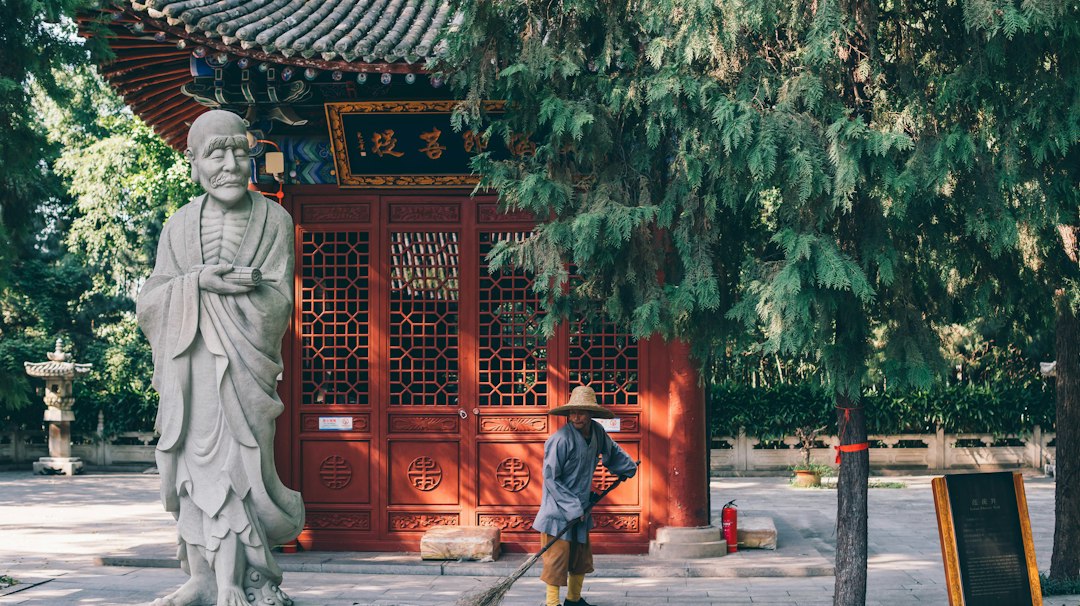 Photo by Hero ding on Unsplash
Walk the central line. You’ll feel it before you see it. The orientation matches traditional Li Fang urban planning, running strictly north-south. This isn’t accidental. It aligns with the Celestial Pole, anchoring the site to the stars rather than just the ground.
In the Feng Shui analysis of Qufu’s Confucius Temple, Cemetery, and Mansion, the first thing that stands out is this axis alignment. It acts as a spine. Qi moves along it like blood through an artery. If the spine bends, the body fails. Here, it remains straight.
If you want to understand how global sites manage this kind of longevity, you might browse these World Heritage guides to see how other cultures handle sacred orientation. Qufu isn’t unique in seeking alignment, but it’s unique in maintaining it for two millennia.
The layout demands respect. You don’t just walk through; you proceed. Every gate marks a shift in energy density.
The Secret Sauce: Feng Shui Principles in Sacred Architecture
Here’s the thing: buildings breathe. They intake Qi through gates and exhale it through courtyards. Qufu optimizes this flow through deliberate placement.
You’ve got Yin-Yang balance in the spatial organization. Open courtyards (Yang) alternate with enclosed halls (Yin). This rhythm prevents energy from stagnating. Stagnant Qi breeds decay. Moving Qi sustains life.
Form School vs Compass School: Two Schools, One Goal
Two schools dominate Feng Shui theory. Form School looks at the land. Compass School looks at the degrees. Qufu uses both.
Form School analysis reveals the topographic backing. The site sits with mountains behind (the “dragon”) and water in front. This creates a protective arm formation. You can’t see the mountains from every angle, but the landform implies them.
Compass School requires precision. Luo Pan compass readings indicate 24 Mountain orientations. The main halls face specific degrees to capture auspicious stars. (Shandong Cultural Heritage Bureau). This isn’t guesswork. It’s calculation.

When you apply this to your own space, you don’t need a massive temple. You do need to check your backing. Do you have a solid wall behind your desk? Or a window drafts? The principle scales down.
Material selection follows Five Elements theory. Wood beams grow. Stone bases ground. Fire rituals cleanse. Metal bells ring. Water features flow. All five exist here. Missing one creates imbalance.
If you’re curious about the broader context of how these elements play out in other historic sites, this definitive guide to UNESCO sites breaks down the material choices across 1,199 locations. It helps you spot patterns you’d otherwise miss.
The Temple: A Ritual Machine, Not Just a Museum
The Temple isn’t just a museum. It’s a machine for ritual. Every bay serves a function.
Symmetry reflects Confucian hierarchy. Left and right mirror each other. This stabilizes the energy. Chaos hides in asymmetry. Order breeds calm.
Water features sit at specific nodes for energy purification. They don’t just look nice. They slow down rushing Qi. Fast water drains wealth. Slow water accumulates it.
Meridian Energy Channels: The Site as a Body
Think of the site as a body. It has meridians. The Dragon Gate (Longmen) placement theory dictates where the main energy enters. It’s not the front tourist entrance. It’s the spiritual threshold.
The ancestral hall correlates with Earthly Branches. Specific times of day activate specific halls. This ties the building to the clock.

The main hall adheres to cosmic numerology. It is nine bays wide. Nine represents the emperor and the heavens. Using this number claims divine authority.
According to the Feng Shui analysis of Qufu’s Confucius Temple, Cemetery, and Mansion, this numerology plays a critical role. It signals intent. You wouldn’t build a storage shed with nine bays. You build a throne room.
If you’re renovating your home, consider your own “bays.” How wide is your main living space? Does it feel grand or cramped? Scale matters.
You can find more resources on architectural symmetry to see how these proportions translate to residential design. It’s not about copying temples. It’s about copying the feeling of stability.
The Cemetery: Ancestral Energy, Preserved Across Generations
Death isn’t an end in Feng Shui. It’s a transition. The Cemetery preserves the ancestor’s Qi to benefit the living descendants.
Hill encirclement creates protective “arm” formations. The grave sits in the palm of the land. Wind cannot scour it. Water does not flood it.
Tree species selection maintains Five Elements balance. Pine trees dominate. They represent longevity. They don’t drop leaves constantly. Deciduous trees create too much decay energy near the grave.

Burial mound orientation matches stellar constellations. The head points to specific stars. This connects the deceased to the cosmic grid.
Geomantic Impact on Descendant Prosperity
Does this actually work? Look at the lineage. The Kong family maintained recognition for over 70 generations. That’s not just politics. That’s energy continuity.
Dragon vein continuity runs across generations. The land supports the bloodline. When the land is damaged, the lineage struggles.
Water convergence at the Spirit Way entrance collects Qi. It pools before entering. This ensures the energy is rich before it touches the grave.
Studies on ancestral sites often cite specific institutional trajectories or reputation changes linked to geomantic integrity (Journal of Asian Architecture). When the trees were cut during certain动荡 periods, the family’s influence waned. When restored, it stabilized.
This is heavy stuff. You might not have a family cemetery. But you do have photos of ancestors. Where do you keep them? In a dark drawer? Or on a respected shelf? Placement signals respect. Respect generates Qi.
The Mansion: Living Space Harmony, Not Just Ritual
The Mansion is where the living slept. It differs from the Temple. Less ritual. More comfort.
Residential-administrative zone separation keeps work energy out of sleep energy. The front offices handle business. The back courtyards handle rest. You shouldn’t dream about taxes.
Screen wall (Yingbi) function blocks direct wind and evil spirits. It forces Qi to curve around. Straight lines shoot energy too fast. Curves soften it.

Courtyard ratios follow Golden Mean proportions. Rooms feel balanced. Not too tall. Not too wide. This reduces psychological stress.
The Feng Shui analysis of Qufu’s Confucius Temple, Cemetery, and Mansion demonstrates how to live daily within a sacred context. You don’t live in the temple. You live in the house next to it.
If you’re looking for tools to measure your own room ratios, check these measurement and design tools. Getting the proportions right changes how you feel in a room instantly.
Cultural Legacy: Preservation as Active Practice
Preservation isn’t static. It’s active. Annual ritual timing follows Feng Shui almanacs. Dates shift yearly based on stars. You can’t just pick a Saturday.
Modern conservation challenges clash with traditional principles. Tourists walk where spirits should rest. Noise disrupts the quiet needed for Qi accumulation.
Tourism impact on energy flow patterns is real. Too many people create chaotic Yang energy. The site needs quiet periods to recharge.

The 曲阜孔庙、孔林和孔府风水分析 reveals that maintenance is key. A broken tile isn’t just cosmetic. It’s a leak in the energy field. Fix it.
You have to balance access with sanctity. Open the gates, but keep the core protected. This applies to your home too. Welcome guests, but keep your bedroom private.
FAQ
What makes Qufu’s Confucian sites different from regular temple complexes?
These sites aren’t just religious spots—they’re living blueprints of Feng Shui mastery. They integrate mountain-water synergy, precise cardinal orientation, and multi-generational energy continuity absent in typical religious sites. Most temples focus on worship; this complex focuses on lineage endurance.
How does the cemetery’s layout reflect Feng Shui principles?
The concentric hill arrangement creates protective “arms,” while precise tree planting maintains Five Elements balance and ancestral Qi circulation. It’s designed to trap beneficial energy rather than let it scatter.
Can modern buildings replicate these Feng Shui techniques?
Contemporary architects adapt Qufu’s principles through site-specific orientation, natural element integration, and spatial sequencing that mimics traditional energy flow patterns. You don’t need ancient wood, just intentional placement.
Why is water placement critical in Qufu’s Feng Shui design?
Water features regulate Qi velocity, provide Yin complement to mountain Yang energy, and serve as ritual purification elements aligned with cosmic water systems theory. Still water accumulates wealth; moving water clears stagnation.
Next Steps for Your Space
You’ve seen how a 2,500-year-old site manages energy. You can’t build a temple in your backyard. You don’t need to.
Start with the axis. Clear the path from your front door to your main window. Let light travel. Then check your backing. Ensure your main seat has a wall, not a void.
Small shifts create big changes. The Kong family didn’t get lucky. They got deliberate. You can too.
If you want to dig deeper into applying these concepts to your own living environment, discover more Feng Shui tips for your living space to start optimizing your home’s energy flow today.