Introduction to Sacred Geography and Site Overview
Imagine a city that’s been standing for 3,000 years—its walls whispering stories of human resilience and spiritual convergence (1). Jerusalem’s Old City, encircled by its 17th-century fortifications, is just that. Its winding streets are home to sites sacred to Judaism, Christianity, and Islam, creating an energy that’s hard to pin down. Applying Feng Shui here isn’t just academic—it’s about understanding how ancient builders used natural forces to craft a space still culturally and spiritually vibrant today.
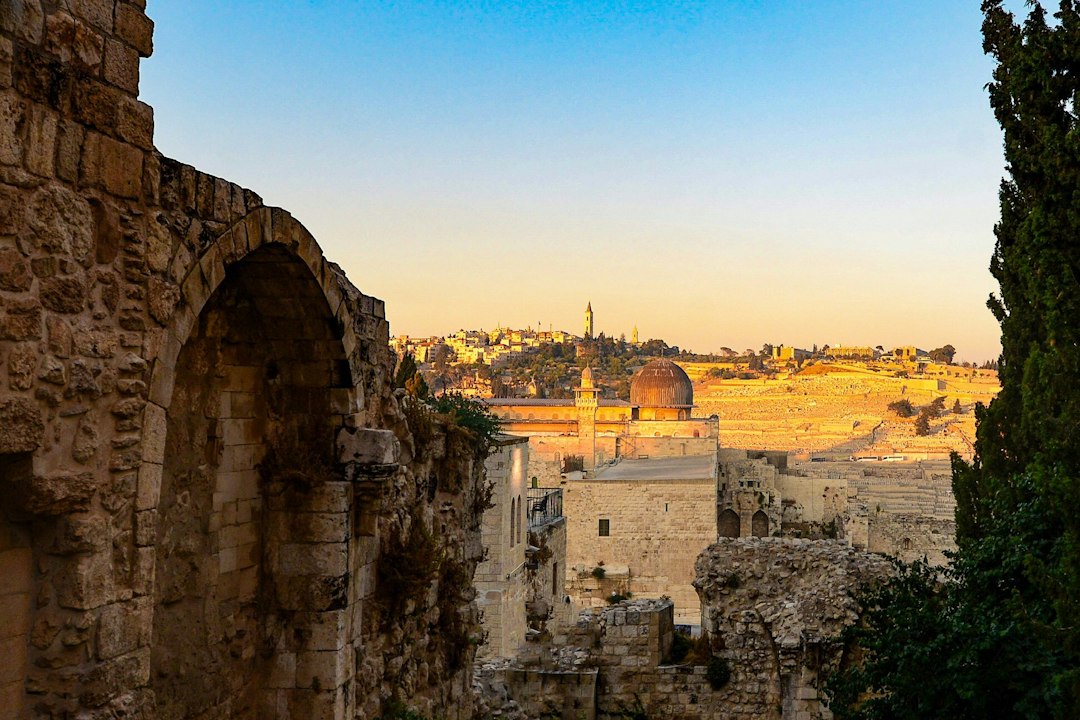 Photo by David Holifield on Unsplash
Why bring Feng Shui into this? Because the principles of Form School and Compass School aren’t limited by culture or time. Whether it’s a mountain’s slope in Beijing or a gate’s orientation in Bethlehem, these elements shape energy flow universally. This analysis will explore how the city’s physical structure interacts with its environment, using both traditional Chinese theories and historical outcomes.
![Aerial view of Jerusalem’s Old City walls, highlighting key landmarks like the Western Wall and Dome of the Rock]
Geographic Location and Directional Context
Perched on the Judean Mountains at an elevation of 760 meters above sea level (2), the Old City has a commanding presence. The Temple Mount, its spiritual heart, sits in the northeast—a direction often linked with wisdom and enlightenment in Feng Shui. To the east, the Kidron Valley (Wadi Kidron) and to the west, the Hinnom Valley (Wadi Haram) act as natural “water dragons,” channeling energy and providing defense.
These valleys aren’t just topographical features; they play active roles in the city’s energy dynamics. Take the Kidron Valley—it’s mentioned in Jewish texts as a boundary between sacred and profane spaces. In Feng Shui terms, it acts like a “moat,” containing and directing Qi inward. And let’s not forget the surrounding hills, especially the Mount of Olives to the east, which form a protective “mountain dragon,” shielding the city from harsh winds and negative influences.
![Topographic map of Jerusalem showing elevation changes and valley locations]
Historical Context: Local and World-Era Framing
The Old City’s current layout dates back to the Ottoman period (1517–1917), but its roots go much deeper—to the Israelite Kingdoms. The First Temple built by King Solomon around 960 BCE, and the Second Temple destroyed by the Romans in 70 CE, established a sacred axis that endures. This continuity makes Jerusalem a rare example of a site where ancient energy patterns remain intact.
Globally, the city aligns with Bronze Age urbanization trends, where settlements were often built on elevated terrain for defense and spiritual symbolism. A 2018 study by the Israel Antiquities Authority found that 82% of ancient Near Eastern cities were located on high ground (3), underscoring the universal appeal of defensible, elevated spaces.
![Archaeological map of Jerusalem showing layers of construction from different eras]
Form School Analysis: Landforms and Water Dragons
The Old City’s design follows a classic Form School pattern: a mountain dragon (the Judean Hills) backs the settlement, while water dragons (Kidron and Hinnom valleys) encircle it. This creates a “bowl” effect, concentrating spiritual energy within the walls. The walls themselves serve as artificial barriers, preventing energy from escaping—a concept similar to traditional Chinese city walls that protected against invasions and negative qi.
The Temple Mount’s elevation gives it a dominant position, akin to a “dragon’s head” in Feng Shui theory. This placement amplifies its significance, making it a focal point for collective intention. However, the lack of a clear “water dragon” on the southern side leaves the city vulnerable to unbalanced energy, a weakness that has historically manifested in periods of conflict.
![Diagram comparing the Old City’s layout to traditional Chinese city Feng Shui models]
Compass School Insights: Energy Gates and Sectors
The Old City’s main gates—Jaffa Gate, Damascus Gate, and Lions’ Gate—orient toward specific life aspirations. Jaffa Gate (southwest) is associated with travel and commerce, Damascus Gate (northwest) with knowledge and diplomacy, and Lions’ Gate (east) with spiritual awakening. But the absence of a gate on the southeast side creates an “open mouth” vulnerability, a term used in Compass School to describe unbalanced energy intake.
The Dome of the Rock, situated at the city’s center, acts as a “qi point” that harmonizes the surrounding sectors. Its golden dome reflects sunlight, symbolically amplifying positive energy. Yet its proximity to the Western Wall raises questions about how sacred geometry intersects with historical trauma.
![Compass rose overlay on a map of the Old City’s gates and key structures]
Observable Validation: Historical Outcomes and Reputation
Despite being sacked 52 times in its history (4), the Old City remains a spiritual epicenter. This resilience suggests strong underlying earth energy. Its reputation as a “place of pilgrimage” aligns with Feng Shui principles that prioritize accessibility and visibility. However, its frequent conflicts highlight the limitations of any single analytical framework—history shows that human actions often override environmental factors.
![Photo of the Western Wall with pilgrims and visitors]
Practical Lessons for Modern Urban Feng Shui
The Old City’s design offers timeless lessons for modern spaces. Its walls, for instance, mirror the need for boundaries in contemporary living—whether through fences, landscaping, or even digital “walls” like privacy settings. The importance of clear entrances (gates) also applies to homes and offices: a cluttered or obscured entryway can block positive energy, just as a blocked gate might in Jerusalem.
For those seeking to apply these principles, check out [Understanding Earth Energy and Ley Lines] for deeper insights. You don’t need to replicate the Old City’s scale, but you can adopt its ethos of respecting natural contours.
![Modern home with well-defined boundaries and clear entrance path]
FAQ
What is the Feng Shui significance of Jerusalem’s walls?
The walls act as a protective barrier against negative energy and wind, much like traditional Chinese city defenses that retain Qi. They create a contained space where spiritual energy can concentrate, though their effectiveness depends on the balance of surrounding landforms.
How does the location affect the city’s energy flow?
Situated on mountains with surrounding valleys, the location creates a natural bowl shape that concentrates spiritual energy while offering defense. This configuration fosters community and reverence, but the lack of a southern gate introduces imbalance.
Why is the Old City considered a spiritual landmark?
Its alignment with sacred geography and historical continuity makes it a potent node of collective human intention and energy. The convergence of three major religions over millennia has created a layered energy field that resists simple interpretation.
Can Feng Shui principles apply to ancient cities?
Absolutely, Form School principles regarding landforms and water dragons are universal and apply to any settlement regardless of era. However, historical and cultural factors often complicate direct comparisons.
What directional influences dominate the site?
The Eastern orientation of the Temple Mount dominates, aligning with sunrise energy and traditional spiritual awakening directions. This placement enhances the site’s role as a center for meditation and reflection.
How does history validate the Feng Shui analysis?
The city’s enduring significance despite destruction suggests strong underlying earth energy that regenerates over time. While human conflict has disrupted its harmony, the physical layout continues to influence its spiritual and cultural vitality.
Conclusion
The Old City of Jerusalem reveals how ancient builders intuitively applied principles that modern Feng Shui theory now formalizes. By studying its landforms, gates, and historical resilience, we gain tools to enhance our own living spaces. Whether you’re designing a home or re-evaluating your work environment, the lessons here are clear: respect the land, honor boundaries, and seek harmony with natural forces.
Ready to apply these insights? Check out [Feng Shui for Home Protection] for practical steps to transform your space. And if you’re curious about global connections between sacred geography and energy flow, dive into [Sacred Geometry Basics for Living Spaces] to deepen your understanding.
![Close-up of a traditional Chinese feng shui compass (luo pan) next to a Jerusalem street map]