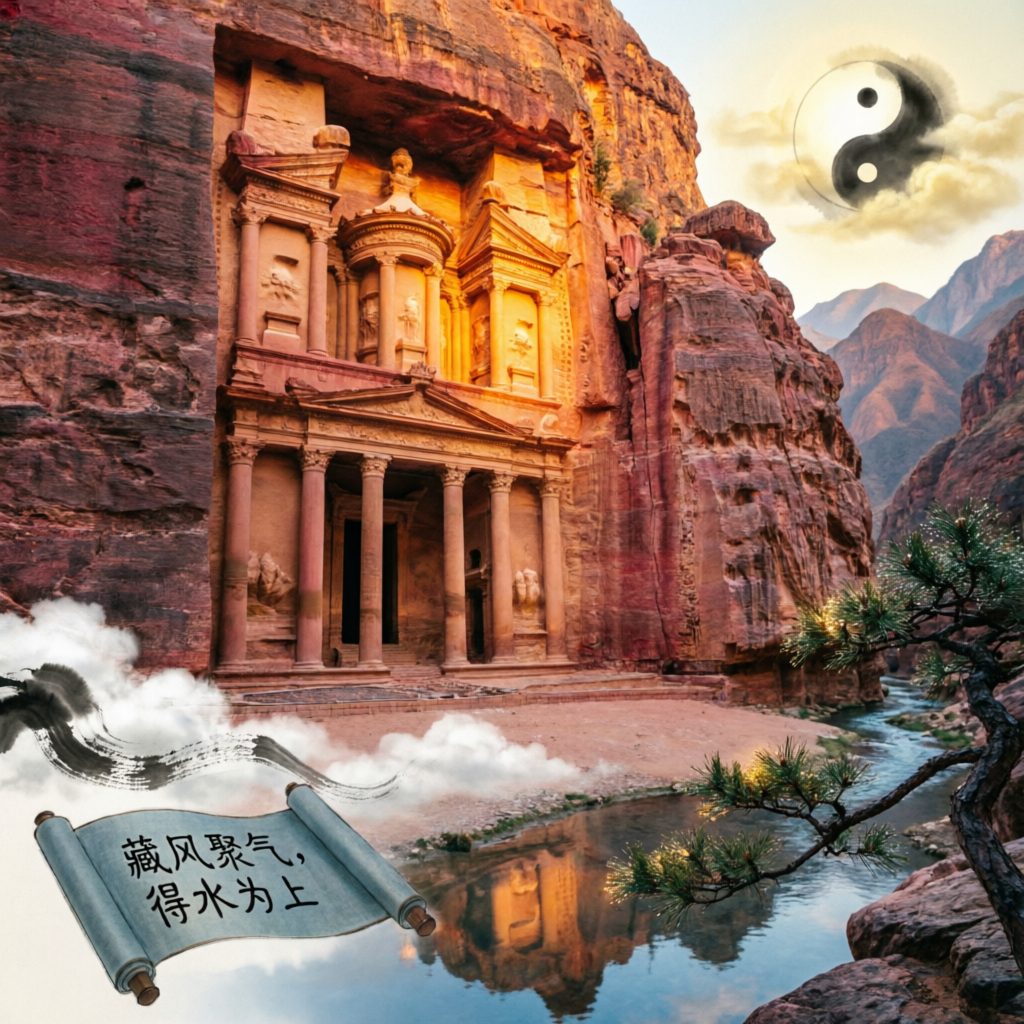
Let’s be real: if you’ve ever stood in front of Petra’s Treasury and felt your breath catch, you weren’t just admiring a ruin. You were standing in the presence of something ancient, intentional, and deeply smart. Built over 2,000 years ago by people who didn’t have Google Maps or climate control, this city survived not because it was lucky—but because its creators understood something we’ve mostly forgotten: that the land doesn’t need to be tamed. It needs to be listened to.
In 2023 alone, more than 800,000 visitors climbed those same stone steps (Jordan Tourism Board). That’s not tourism hype—it’s proof that Petra still speaks to us. And what it’s saying? “Work with nature, not against it.” Which, spoiler alert, is basically feng shui—but without the crystal grids and questionable bagua charts most people associate with it.
Feng Shui Isn’t About Crystals — It’s About Energy Flow
Feng shui? Don’t roll your eyes yet. The Form School (形势派) isn’t about placing a tiger statue in the northeast corner—it’s about how terrain moves energy, or qi. And Petra? They got it down. Instead of bulldozing hills or flattening valleys, the Nabataeans carved their temples, tombs, and homes directly into the sandstone cliffs. Why? Because they knew: when you integrate with the land, you don’t fight erosion—you work with it.
The Compass School (理气派), which focuses on directional alignments using the eight trigrams, gets all the press—but Petra’s real magic lies in its Form School roots. No rigid grids here. No forced layouts. Just smart, adaptive architecture that lets the earth guide the buildings. Wind hits the eastern mountains—300 meters high—and instead of blasting through the city, it gently diffuses around them. Modern engineers would call that “wind mitigation.” The Nabataeans called it “listening to the sky.”
Water, Stone, and Sky: The Quiet Symphony of Petra
Here’s where things get practical—and beautiful. Petra’s Siq gorge isn’t just a dramatic entrance; it’s a hydraulic masterpiece. Winter rains funnel through 70 hand-carved rock channels into underground cisterns, turning desert dryness into usable lifeblood. Yin meets yang—not metaphorically, but literally. Water flows beneath stone, balancing the elements so the city could thrive in one of Earth’s harshest environments.
And look at the valley itself. Wider spaces for gathering energy, narrower passages to channel it. Think of it as ancient urban design—with soul. Today’s architects are finally catching up, using tapered facades to mimic natural airflow patterns. But Petra did it 1,500 years earlier… without steel, without computers, and definitely without Instagram filters.
Architecture That Aligns With the Heavens (and Your Soul)
Al-Khazneh—the Treasury—isn’t just photogenic. It’s a solar clock disguised as a temple. During the spring equinox, the shadow of the urn atop the façade falls perfectly onto the central doorway. Not a coincidence. Not decoration. A deliberate alignment. The Nabataeans didn’t build monuments to impress—they built instruments to mark time, space, and spirit.
Pathways follow the land’s curves, not imposed grids. Streets widen near temples to create “energy buffers”—like modern zoning laws, but with spiritual intent. Imagine walking down a street where every turn feels intentional, every corner designed to slow you down, invite reflection, maybe even let you breathe. That’s Petra’s gift: it doesn’t rush you. It invites you to move with the flow.
Sacred Spaces That Move Qi (Not Just Souls)
The Monastery (Ad Deir) sits 480 steps above the city center. Climbing those stairs wasn’t just exercise—it was a physical journey upward, mirroring the movement of qi. Pilgrims weren’t just ascending stone; they were ascending energy levels. In fact, many of the tombs feature star-shaped niches that refract sunlight into shifting geometric patterns throughout the day. It’s like living art that changes with the hour—and yes, that’s intentional.
Statues found nearby show hands in mudras—postures associated with meditation and energy absorption. These weren’t burial sites for the dead. They were portals for the living to connect with the unseen forces around them. The Nabataeans didn’t separate sacred from practical. Their tombs doubled as altars. Their courtyards doubled as classrooms. Everything had purpose. Everything flowed.
How to Bring Petra’s Wisdom Into Your Daily Life
You don’t need to live in Jordan—or even own a cliffside villa—to apply these lessons. Here’s how:
-
Stop fighting your floor plan. If you’ve got a sloped backyard? Turn it into terraced gardens. Mimic Petra’s stepped water systems—even if yours are decorative. Nature loves layers.
-
Use mirrors strategically. Petra’s reflective sandstone surfaces redirected qi—and light. Place a mirror opposite a narrow hallway or entryway to visually expand space and encourage energy flow. Bonus points if you add a plant nearby. Nature + reflection = harmony.
-
Choose materials that speak to your environment. The Nabataeans used local stone to avoid thermal shock. You can do the same: concrete in humid climates to manage moisture, wood in arid ones to retain warmth. Work with what’s around you—not what looks trendy.
This isn’t mysticism. It’s physics dressed in poetry. And honestly? We could use more of that in our modern lives.
FAQ: Quick Answers to Big Questions

What makes Petra unique from a feng shui perspective?
Most ancient cities tried to conquer nature. Petra embraced it. The Siq’s winding path isn’t scenic—it’s a qi regulator, slowing energy before it hits populated areas. Rome laid out grids. Egypt built isolated temples. Petra? It became part of the landscape. That kind of symbiosis is rare—and incredibly effective.
How can I apply Petra’s principles to my home?
Start small:
- Add a tabletop fountain near your front door. Moving water = moving energy.
- Soften sharp corners with rugs, plants, or curved furniture. Petra’s “softened corners” principle reduces stress and enhances flow.
- Use natural materials that suit your climate. Simple, sustainable, smart.
[CTA: Ready to transform your space? Explore our guide to [LINK: feng shui basics for modern homes] or discover how to [LINK: channel Petra’s energy principles in apartment layouts].]
Want to dig deeper? Check out World Heritage Sites: A Complete Guide to 1,031 UNESCO World Heritage Sites—it reveals why Petra’s 1985 designation mattered beyond aesthetics. Or grab World Heritage: Petra ($33.95 paperback), which breaks down how Nabataean engineers calculated solar angles to within 1°. These aren’t coffee-table books. They’re blueprints for living well—with the past, not despite it.
Because sometimes, the oldest ideas are the most alive. And Petra? It’s still talking. You just have to listen.