What You’ll Actually Take Away From This
Stand at the edge of Wadi Rum just after dawn and the first thing that hits you isn’t the color — though there’s plenty of that. It’s the sheer scale. Jabal Rum looms 1,754 meters above sea level, while the valley floor sits around 800 to 900 meters below. That’s nearly a kilometer of vertical drama in one sweeping view (UNESCO World Heritage Centre, 2011). It’s the kind of view that makes you feel small — and oddly alert.
And that kind of terrain does something to the energy. The qi, if you’re into that sort of thing.
By the end of this, you’ll be able to read Wadi Rum like a feng shui pro — not just nodding along but actually spotting where the dragon veins run, where qi pools and where it leaks, and why some spots feel expansive while others feel like you’re being boxed in. You’ll also know which of the “desert energy” claims are just fluff dressed up as mysticism. Spoiler: there’s a lot of fluff.
This is a full feng shui reading of the Wadi Rum Protected Area using traditional Form School methods. I’ll show you where the analysis holds up, where it’s a bit of a stretch, and where we’re just making educated guesses.
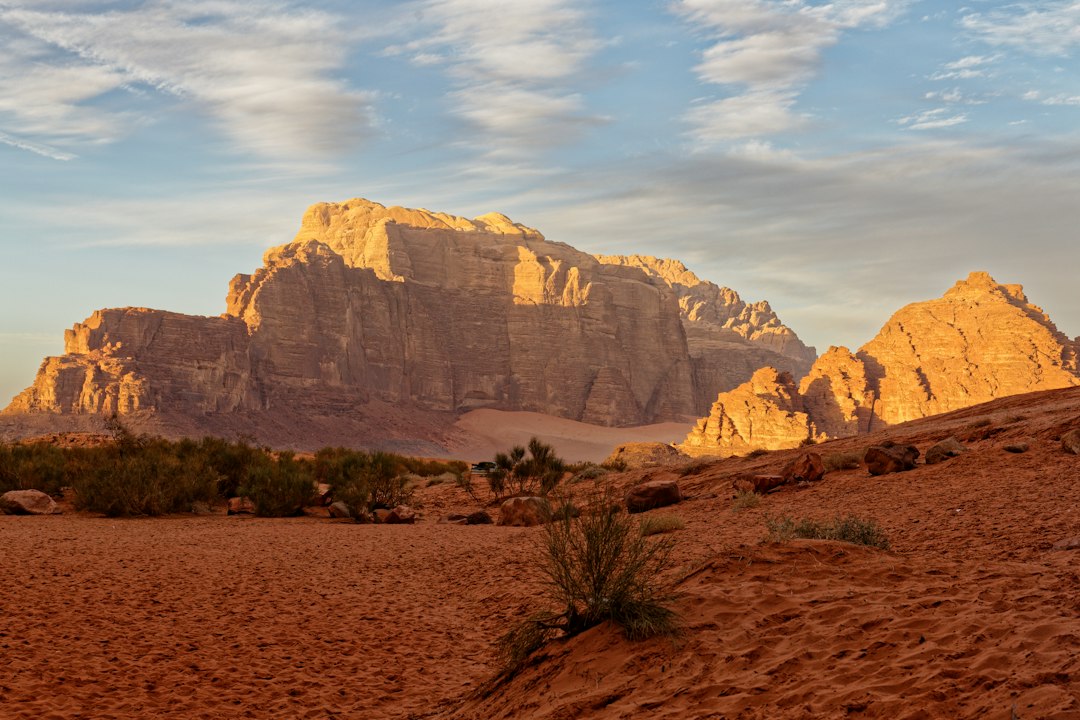 Photo by Sergejs S. on Unsplash
Before You Dive In — What You Should Know First
You don’t need a luo pan (the fancy feng shui compass). You don’t need to memorize all 24 directions. But you do need three things:
A basic grasp of 形势派 — Form School feng shui.
This is the older, more intuitive branch. It’s about reading the land as it is — mountains, valleys, ridges — not by crunching compass numbers. If you can look at a hill and say, “That’s a protective ridge,” or “That’s an exposed slope,” you’re already halfway there.
A rough sense of direction.
Wadi Rum is in southern Jordan, about 70 km north of Aqaba. Direction matters because it changes how the landscape handles qi — not just how it looks. North and south aren’t just labels here — they’re functional.
And a willingness to separate vibes from actual evidence.
A lot of desert feng shui writing is just tourist copy with the word “energy” sprinkled on top. We’re not doing that here.
If you want a reference to keep on hand — especially if you’re diving into the classical texts — 图解风水百科2000问 is a solid pick. It’s a 2,000-question illustrated encyclopedia in Chinese, covering Form School terms, compass theory, and the vocabulary that makes readings like this one make sense. It’s $17.50, and if you can read Chinese or don’t mind using a translation tool, it’s worth the shelf space.
Alright, let’s get into the actual reading.
Step 1: Set the Stage — Geography, Approach, and Orientation
You can’t read the qi until you understand the lay of the land — and how people move through it.
Location
Wadi Rum Protected Area spans about 74,180 hectares — roughly 741 square kilometers — in southern Jordan’s Ma’an Governorate. To the west, it’s bounded by the Aqaba escarpment and the Dead Sea Transform fault. To the east, it opens into the broader Arabian desert. The Red Sea lies about 70 km to the southwest.
The Rock
This isn’t your typical sand desert. It’s a maze of sandstone, carved over millennia into mesas, arches, canyons, and those iconic mushroom-shaped pillars. The foundation is granite, overlaid with Paleozoic sandstone. The big names here are Jabal Rum, Jabal Khazali, and the Barrah massifs — the ones that dominate the skyline.
The Human Layer
People have been reading this landscape — and carving into it — for a very long time. There are around 25,000 petroglyphs and 20,000 inscriptions etched into the rock, some dating back 12,000 years (UNESCO documentation). Thamudic, Nabataean, Greek, and Arabic scripts all show up. The Nabataeans, who built Petra 100 km to the north, used this area as a trade corridor. And during the Arab Revolt of 1917–1918, T.E. Lawrence made it his base — hence the “Valley of the Moon” nickname in tourist brochures.
In terms of world heritage, Wadi Rum was listed as a UNESCO site in 2011, recognized for both its natural and cultural value. That’s important here because feng shui also looks at both — the land and how people have interacted with it.
If you want to dig deeper into its UNESCO context, World Heritage Sites: A Complete Guide to 1,031 UNESCO World Heritage Sites is a solid reference. It’s $33.95 and packed with maps and criteria. It’s not light reading, but it’s useful for comparing Wadi Rum with other mixed-criteria sites.
Approach and Orientation
Most visitors enter from the village of Wadi Rum on the western edge, then head east into the protected area. The main valleys run northeast–southwest. So the typical journey is: enter from the west, travel deeper into a landscape that becomes increasingly enclosed, with towering massifs on both sides.
That’s your baseline. Everything that follows builds on that.
Step 2: The Form School Reading (形势派)
Form School feng shui — 形势派, or the “landform school” — asks a simple question: does this place protect and gather energy, or does it expose and scatter it?
The ideal is 藏风聚气 — “conceal the wind, gather the qi.” You want a site where wind is blocked by surrounding high ground, where energy (often symbolized by water) collects rather than drains, and where there’s a clear focal point — 穴 (xue), the spot where qi settles.
The framework used is the Four Celestial Animals:
- 青龙 (Green Dragon) — the eastern flank, ideally a long, undulating ridge
- 白虎 (White Tiger) — the western flank, ideally lower and more subdued
- 朱雀 (Red Bird) — the southern approach, open but with a low “案山” (table mountain) in the middle distance
- 玄武 (Black Tortoise) — the northern rear, a solid, protective mass
Wadi Rum fits this model — sort of. Let’s unpack it.
Mountains and Water — Or the Lack of It
Massifs as Dragon and Tiger.
Wadi Rum’s central valleys do have flanking high ground. Jabal Khazali and the western ridges form one side of the main wadi; Jabal Rum and the eastern massifs form the other. If you pick a specific viewpoint — your “seat” — you can clearly identify a dominant protective flank and a more subdued one.
But here’s the catch: these ridges aren’t subtle. Classical Form School prefers rounded, flowing ridges — the dragon should undulate, not spike. Wadi Rum’s cliffs are sheer, fractured, and vertical. In traditional terms, that’s 煞 (sha) — sharp, aggressive energy. A strict practitioner might say this is high-drama sha qi territory: great for inspiration and awe, not so much for rest and recovery.
But that’s not a flaw — it’s a feature. More on how to work with it later.
The Missing Water.
This is the biggest deviation from the classical ideal — and the most interesting part of the whole reading.
Feng shui traditionally treats water as the main carrier of qi. Rivers, lakes, even the sea — they move energy through a landscape and deposit it where it slows. Wadi Rum, though, has no permanent surface water. The wadis are dry riverbeds that only flow during flash floods. Annual rainfall here is under 100 mm (Jordan Meteorological Department).
So the classic “mountain behind, water in front” setup doesn’t quite apply. But what does apply is the geometry that water would take if it were there. The wadis are channels — directional guides for how movement organizes itself through the landscape. In classical terms, a dry wadi is 空亡 — a “void” without a carrier — but it still functions structurally.
Think of the wadis as the landscape’s circulatory system, minus the blood. Not a deficiency — just a different operating mode. Wadi Rum gathers qi through containment (rock walls) rather than circulation (water), making it a very “yang” landscape — bright, exposed, and fast-moving.
The 明堂 (Bright Hall).
Between the massifs, the valley floors serve as the 明堂 — the open area where qi accumulates. Wadi Rum’s are broad, flat, and enclosed — structurally correct. They’re just sun-bleached and scorching instead of shaded and moist.
Verdict on the Form School reading: W