What people notice
You have signed a lease, the walls are landlord-white, and the layout is not yours to change. The front door opens straight onto a long shared corridor, or a hallway runs from the entrance to a window so that you can see through the whole flat from the doorway. In the bedroom the bed only fits one way, and that way puts you directly in the line of the door. You would like the place to feel settled, but drilling, repainting and moving walls are all off the table, and the deposit is watching everything you do.
Why it becomes a problem
These layouts bother people before they can explain why. An entry that opens onto a corridor, or a sight-line that runs straight through the home, offers no pause, no sense of arrival and very little privacy; anyone standing at the door sees inside. A bed lined up with the door can feel exposed at night, especially if you wake whenever someone walks past. In traditional terms this is not about decoration; it is about how qi moves through a space. Renting does not remove the discomfort, it only removes the obvious tools, so any adjustment has to work with what can be packed up and taken with you.
The root cause, in feng shui terms
The cause is almost always geometry rather than anything mystical. A corridor aimed at a door concentrates movement, sound and foot traffic into a single line. Doors set in a straight run let air, light and sight-lines travel through the home without gathering anywhere. A bed placed on the door axis sits in the busiest path in the room, catching draughts, light spill and movement every time the door opens. In each case the underlying issue is an unbroken line — of approach, of sight, of air — and the practical answer is to interrupt that line without blocking the route people actually walk every day.
The principle behind it
Traditional form school (形法, xing fa) reads the shape of a space before it reads direction. Its classical rule is that qi should meander, not rush: 氣宜曲不宜直. A corridor, road or long passage aimed straight at the door is read as sha qi rushing the qi mouth (煞氣直沖), and doors aligned in a straight line let qi travel straight through (穿堂煞) without gathering. For sleep, the same school gives the command position (床不對門): you should be able to see the door from the bed, but not lie directly in line with it. None of this requires a compass reading or a renovation — only a break in the line.
The solution
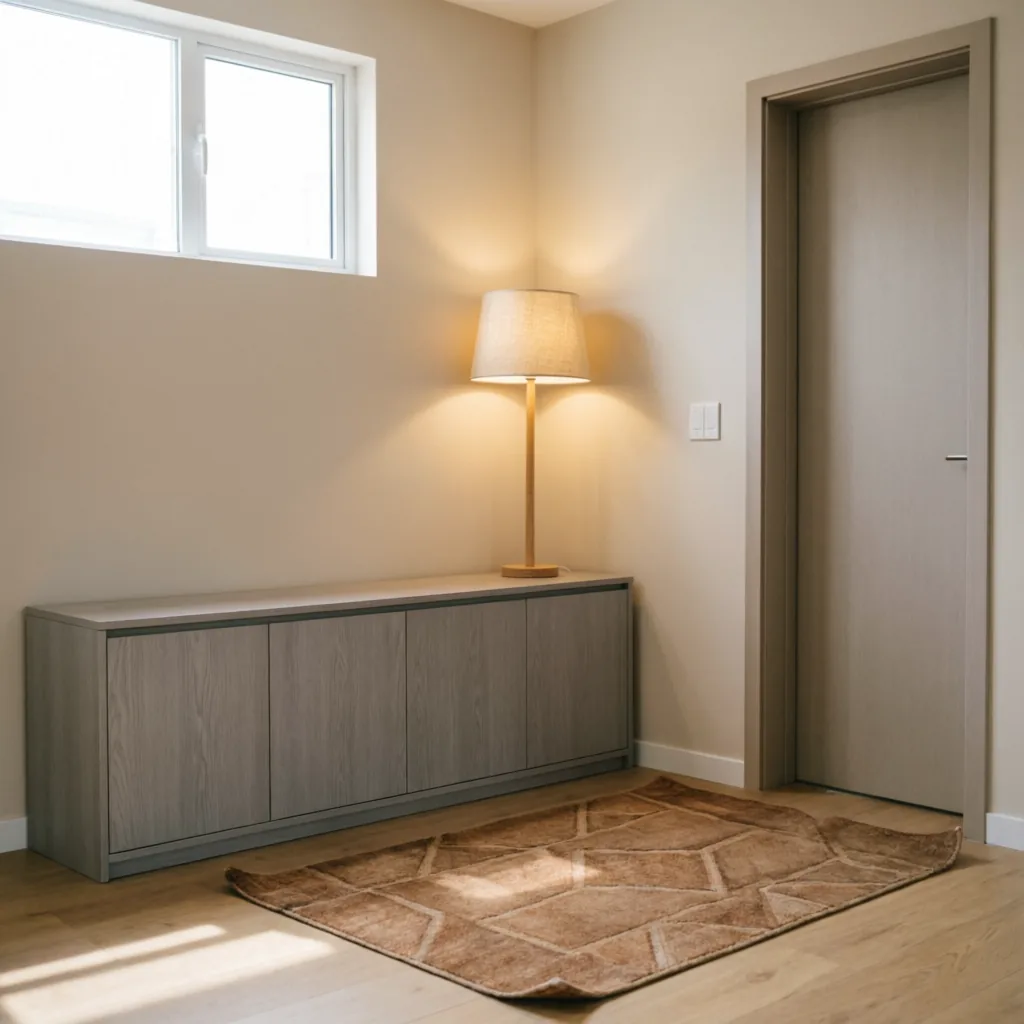
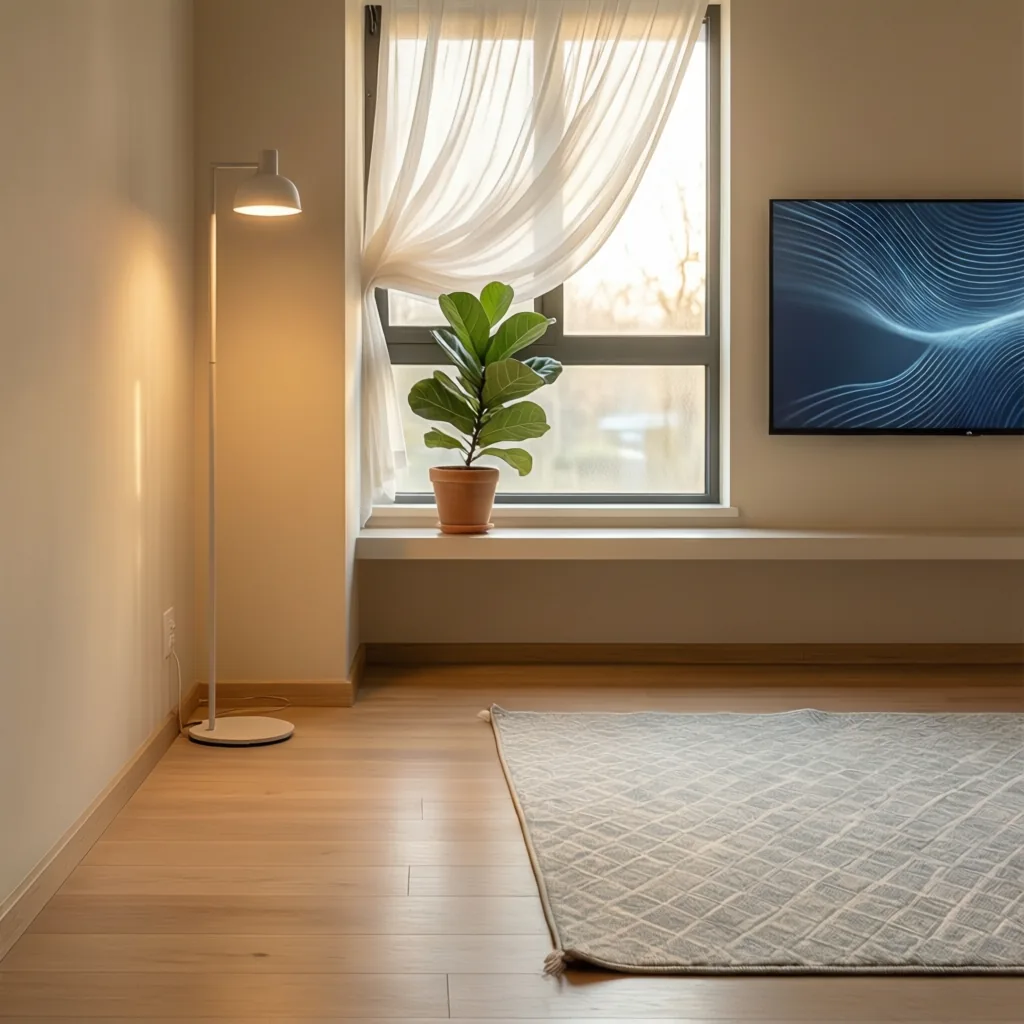
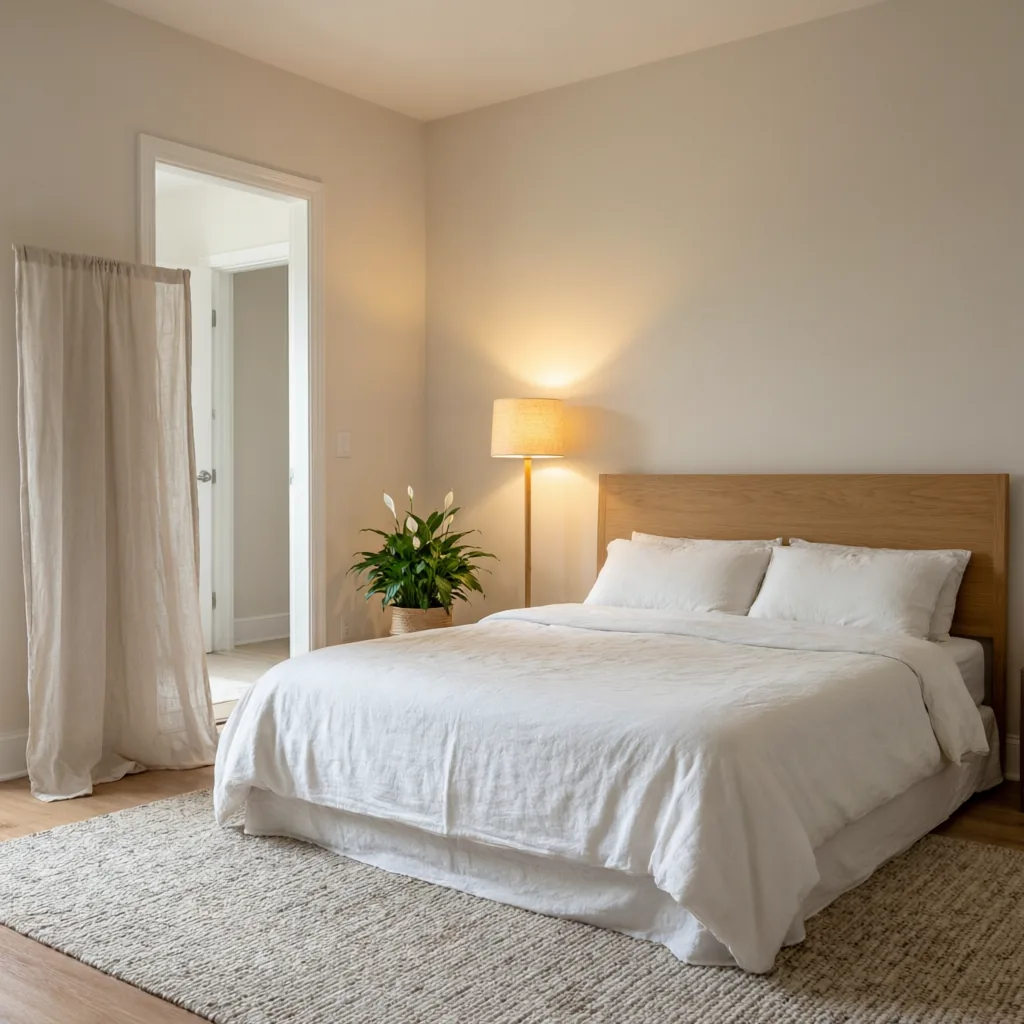
Work in priority order, starting with the cheapest and most consequential move. First, the bed: reposition it so you can see the door while lying down without being in its direct line, with a solid wall behind you. Second, the entry: if a corridor or road aims at the door, place a freestanding screen, slatted divider or tall cabinet across the direct line, or set a rounded-leaf plant between the door and the rush. Third, the through-flow: offset furniture or add a low divider so that a straight run from the front door to a window no longer reads as one open tunnel. A rug and a warm plug-in lamp at the entry are supporting touches, not the main adjustments.
How to put it into practice
Start with the bed, because it costs nothing. Push it against a solid wall and adjust by a foot or two until the door is visible but not straight ahead; if the wall is bare, lean a portable headboard against it with no fixings at all. Next, the entry. Measure the walkway before buying anything: a folding screen or open slatted divider should leave a clear path, and a tall plant in a weighted pot does the same job using less floor space. Lay a washable rug inside the door and plug a warm lamp into a timer. If the front door still aligns with a back window, later slide a low bookcase or bench into the line. Cost level: none to low, and every item travels with you.
What to realistically expect
What people typically notice is a change in feel rather than a dramatic event: arrivals become calmer, the home reads as private instead of see-through, and the bedroom feels less exposed. Some report sleeping more settled after moving off the door line, which is the kind of subjective shift the illustrative cases below describe. Nothing here is promised. Feng shui adjustments do not produce assured results, and they are no substitute for dealing with noise, draughts, poor lighting or a genuinely unsafe layout. Treat any improvement as a change in how the space feels and is used, not as an outcome that has been secured in advance.
Evidence and sources
[traditional] Form school material describes sha qi striking the qi mouth (煞氣直沖), qi that should meander rather than rush (氣宜曲不宜直), through-flow (穿堂煞) where aligned doors let qi pass without gathering, and the command position (床不對門). [case] A corridor-facing apartment entry was eased with a freestanding screen plus a warm entry light, and the resident described arrivals as calmer. A door facing a descending stair was buffered with a shoe cabinet and a plant, and the family said the entry felt settled. A wardrobe mirror facing the bed was covered at night, later relocated, and night waking was reported to decrease. [modern] Observational only: doors opening onto fast traffic or long corridors tend to feel exposed, straight sight-lines reduce privacy, and seeing the door from bed can support a sense of security.
Boundaries and counterexamples
Skip or scale back any adjustment that obstructs a fire escape route, a doorway, a corridor you use daily, or light from a main window. Do not wedge a screen into a narrow studio so that you have to turn sideways to get in; that trades one problem for a worse one. In a very small flat, a plant, a rug or better lighting is the proportionate move. With beds, if the room allows only one position, choose safety and comfort over strict alignment, and prefer a solid headboard and good curtains to a contorted layout. And where a straight sight-line delivers the only daylight you have, keep the light and break the line lower down instead.
Conclusion
The single most useful move is also the free one: take the bed off the door line. After that, break the straight lines at the entry with a screen, a cabinet or a plant, choosing whatever leaves the walkway clear. Renter-friendly feng shui fixes are simply about interrupting rushed lines with things you can carry to your next home.
FAQ
Can I do any of this without drilling or repainting?
Yes. Every adjustment described here is freestanding or portable: a screen, slatted divider or tall cabinet to break a line, a plant in a weighted pot, a washable rug, and a plug-in lamp. Nothing needs a fixing in the wall, and everything can be folded, lifted or unplugged and taken to your next place. Just check the walkway width first so the divider or cabinet does not narrow the route in and out.
My bed can only fit in line with the bedroom door. What then?
The traditional guidance is the command position (床不對門) — see the door from bed, but do not lie directly in its line. If the room genuinely allows only one arrangement, the stated boundary applies: prioritise safety and comfort over strict alignment. In that case a portable or solid headboard against a solid wall, heavier curtains, and shifting the bed even a short distance off the axis are the proportionate moves.
What should I fix first if I can only do one thing?
Take the bed off the door line first, since it costs nothing and affects where you sleep. Second, buffer the entry if a corridor or road aims straight at the door, using a screen, slatted divider, tall cabinet or rounded-leaf plant placed between the door and the rush. Third, soften any straight run from the front door through to a back window by offsetting furniture or adding a low divider so the sight-line meanders rather than rushes straight through.
Does a mirror facing the bed really matter?
Traditional practice treats a mirror facing the bed as an uncomfortable arrangement, and one illustrative case describes a wardrobe mirror that was covered at night and later relocated, with night waking reported to have decreased. That is a report of how a room felt, not a promised result. If moving the mirror is not possible in a rental, draping it at night is a low-cost, no-damage option you can reverse at any time.
Will these fixes bring luck, wealth or better health?
No such outcome is offered or promised here. The principles used — sha qi rushing the qi mouth, qi that should meander rather than rush, the command position for sleep — describe how a space feels to move through and to sleep in. The realistic expectation is calmer arrivals, more privacy and a bedroom that feels less exposed. None of this replaces dealing with real issues such as noise, draughts, inadequate lighting or an unsafe layout.
Want this applied to your address? The free score gives a quick read; the personal report works through your layout, facing and rooms in detail.
Related guides
- Feng Shui for Small Spaces: Why Cleanliness Matters More Than You Think
- Bathroom Feng Shui: Low-Effort, Low-Cost Beginner’s Guide for Renters and Homeowners
Guidance only — feng shui is a traditional practice and no outcome is guaranteed. Apply what fits your home and budget.